

Advisory on Scams Involving the Immigration & Checkpoints Authority (ICA)
The Police and ICA would like to alert members of the public to remain vigilant regarding two distinct scam variants involving ICA.
Scam variant #1: Calls from scammers impersonating ICA officers
2 In the first scam variant, the victims would first receive unsolicited calls from scammers claiming to be from ICA. The scammers would claim that the victims’ personal details had been misused or that their phone numbers had been linked to criminal activities, such as transmitting scam messages. The calls would then be transferred to another scammer impersonating a China official. The purported China official would then demand that the victims transfer monies or hand over cash for purported “investigation” or “bail” purposes. In some cases, victims were asked to meet up with unknown individuals to sign fake documents (e.g., non-disclosure agreement) to lend legitimacy to the purported investigation and make the scam appear more credible. Most victims would only realise that they had been scammed after making multiple monetary transfers or when the scammer became uncontactable. Since January 2026, at least 117 of such cases have been reported, with at least $8.4 million in losses.
Scam variant #2: Fraudulent advertisements offering assistance with Singapore Permanent Resident (PR) applications
3 In the second scam variant, members of the public would encounter advertisements that purportedly offer PR application services on social media platforms such as Facebook to help them obtain PR status in Singapore. Upon clicking on the advertisements, the victims would be directed to a website of a fake consultancy agency where they would be prompted to submit their personal particulars, including their mobile numbers, through a form. The scammers would then contact the victims via WhatsApp and mislead them into paying fees ranging from $200 to around $90,000 to proceed with the PR application, under the pretext of improving their chances of success through investments in companies, purchases of academic certifications and donations. The victims were then instructed to make bank transfers or hand over cash to unknown individuals. The victims would then receive a fraudulent automated acknowledgment email, purportedly from ICA, containing an attachment of a fake In-Principle Approval (IPA) letter bearing the ICA letterhead. Some of the victims would only realise that they had been scammed when they approached ICA to verify the authenticity of the IPA letters. Since January 2026, ICA has been alerted to at least 31 reports from members of the public regarding fake emails purportedly sent by ICA in response to PR applications, with losses amounting to at least $400,000.
4 ICA is aware of commercial entities or consultants who claim to be able to help applicants improve their chances of success in obtaining long-term immigration facilities such as Singapore PR. ICA does not support or endorse such services. Applicants who choose to engage commercial entities or consultants are advised to exercise caution. Members of the public applying for immigration facilities are strongly encouraged to submit their applications directly to ICA through ICA’s website. Those who require assistance or wish to verify if a call or email is from ICA may contact ICA via the ICA Feedback Form or speak with our call agents at 6391 6100.
5 Singapore Government officials, including officials from ICA, will never do the following:
- Ask you to transfer or hand over money, luxury watches, gold or cryptocurrency;
- Ask you to obtain loans from licensed moneylenders;
- Ask you to disclose banking log-in details;
- Ask you to install mobile apps from unverified app stores; or
- Transfer your call to the Police, or any other government officials.
6 Do not trust unsolicited communications, even if the caller appears to have your personal information. Members of the public are also encouraged to adopt the following precautionary measures:
a) ADD – Add the ScamShield App to protect yourself from scam calls and SMSes. Set security features (e.g. set up transaction limits for internet banking transactions, enable Two-Factor Authentication (2FA), Multifactor Authentication for banks).
b) CHECK – Check for scam signs with official sources. You can check the legitimacy of suspicious messages, phone numbers, and website links via the ScamShield app or visit the ScamShield website at www.scamshield.gov.sg. Use IMDA’s SIMCardHowMany tool (SIMCardHowMany (Beta) | FormSG to verify the number of postpaid SIM cards registered under your identity. Report any discrepancies to your telco and the Police immediately.
c) TELL – Tell the authorities, family, and friends about scams. Report any fraudulent transactions to your bank immediately.
7 If you are in doubt, call the 24/7 ScamShield Helpline at 1799 to check. Fighting scams is a community effort. Together, we can ACT Against Scams to keep our community safe.
SINGAPORE POLICE FORCE
IMMIGRATION & CHECKPOINTS AUTHORITY
25 SEPTEMBER 2026
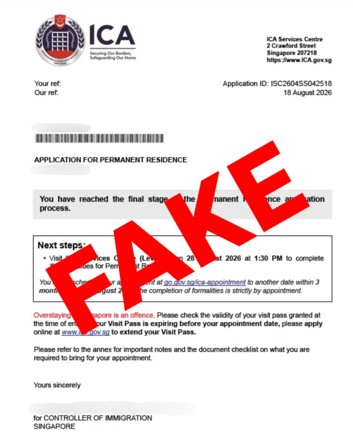
Photo of fake IPA letter from ICA
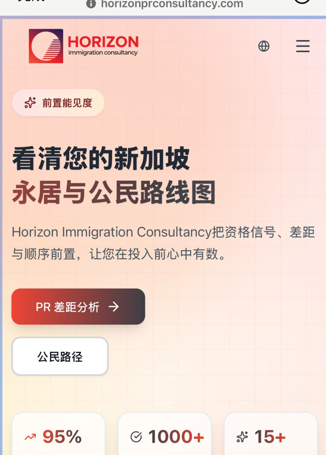
Photo of fake PR consultancy website